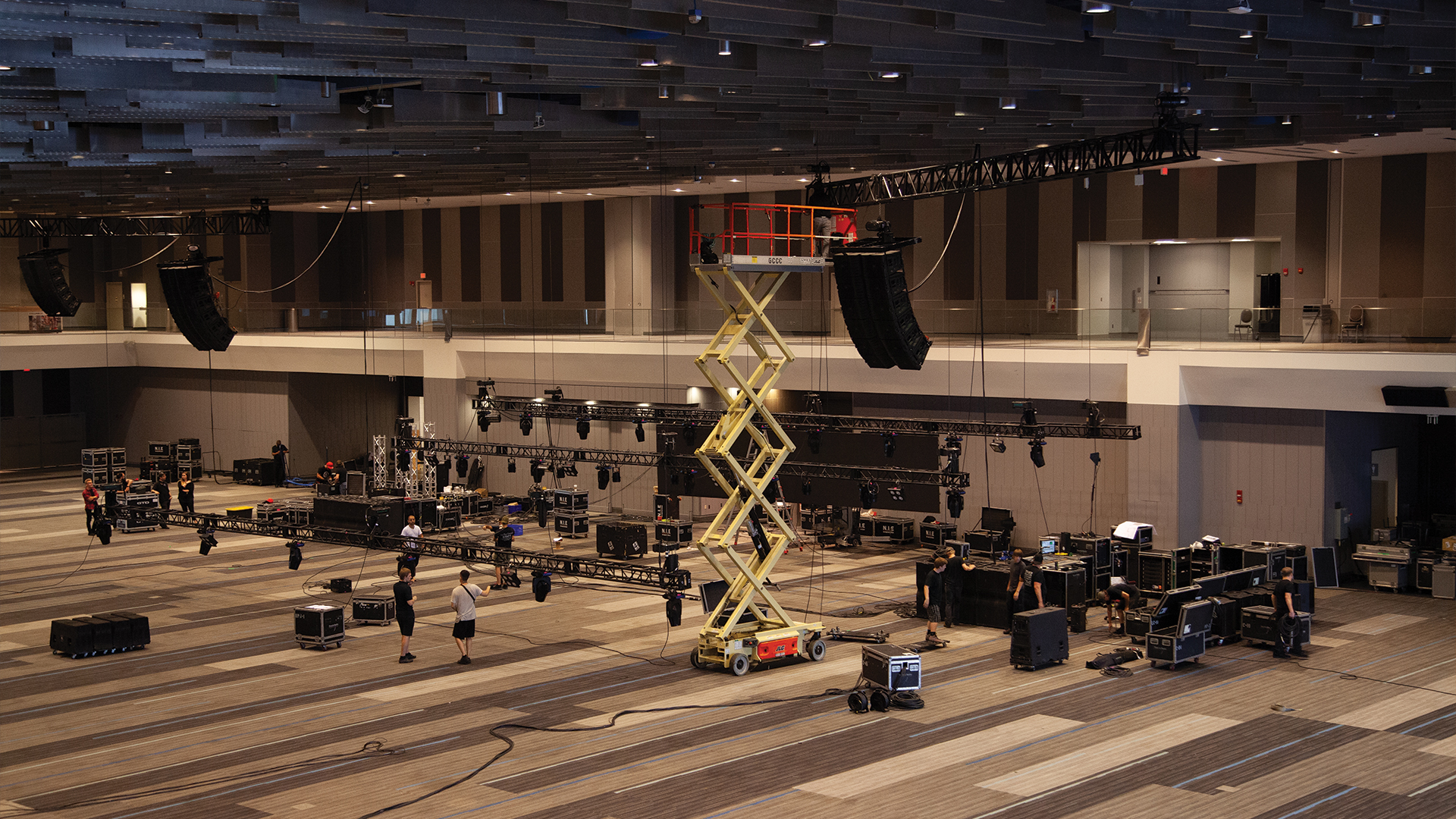
There’s a particular hum that experienced sound engineers recognize instantly—the sound of a PA system about to express an opinion. It’s not quite feedback, not quite signal noise, but something in between that suggests the loudspeaker system has developed preferences about how it wants to be operated. These multi-ton assemblies of drivers, waveguides, and amplification represent decades of acoustic engineering, yet they occasionally behave as if they’ve achieved sentience and decided to negotiate their working conditions.
The Evolution of Sound Reinforcement Personalities
Modern line array systems trace their lineage to acoustic principles established in the 1970s, but the practical implementations that dominate today’s touring industry emerged from manufacturers like L-Acoustics, Meyer Sound, and d&b audiotechnik in the 1990s and 2000s. The L-Acoustics V-DOSC system, introduced in 1992, revolutionized concert sound by demonstrating that multiple enclosures could couple acoustically to project sound tremendous distances with remarkable clarity.
These systems incorporated waveguide technology that enabled precise directional control—a capability that also meant the systems could misdirect sound with equal precision if improperly configured. The J-shaped arrays hanging in contemporary arenas contain multiple transducer sections that must align perfectly to achieve their designed coverage pattern. When alignment drifts—through thermal expansion, mechanical stress, or accumulated wear—the system’s behavior changes in ways that manifest as acoustic attitude.
Feedback: The Original Expression of Displeasure
The screech of acoustic feedback represents a PA system’s most emphatic complaint—a declaration that the relationship between microphones and loudspeakers has become problematic. While engineers understand the physics (sound from speakers reaching microphones creates positive gain loops at specific frequencies), the phenomenon feels personal when it interrupts a critical moment of performance. The Meyer Sound Galileo GALAXY processor includes sophisticated feedback suppression algorithms, as does the Lake LM 44 system, yet feedback finds ways to assert itself at precisely the worst moments.
Venue acoustics dramatically influence feedback behavior. The modal resonances of enclosed spaces—frequencies at which room dimensions create standing waves—become amplified by PA systems, creating feedback at pitches determined by architecture rather than equipment. A system that behaves perfectly in one venue develops aggressive feedback tendencies in another, as if expressing preference for particular acoustic environments.
The Amplifier Opinions
Modern powered line array systems integrate amplification directly into loudspeaker enclosures, eliminating traditional amplifier racks but concentrating thermal and electronic complexity within each cabinet. The L-Acoustics K2 contains three amplifier channels per enclosure, while the d&b audiotechnik KSL incorporates their proprietary D80 amplification technology. These integrated amplifiers monitor their own operating conditions and can autonomously reduce output if thermal limits approach—protection logic that manifests as sudden level reductions precisely when maximum output is required.
The Crown I-Tech HD and Powersoft X8 amplifiers used in conventional passive systems include similar protection circuits. Limiters engage when signal levels threaten driver damage, thermal protection reduces output during extended high-power operation, and load sensing monitors speaker impedance for signs of driver failure. Each protection mode changes system behavior in ways that can confuse operators unfamiliar with specific amplifier personalities.
Network Negotiations and DSP Diplomacy
Contemporary PA systems operate as networked computers running audio through their processors. The L-Acoustics LA Network Manager software controls array configurations across hundreds of enclosures simultaneously, while Meyer Sound Compass provides similar system-wide management. These networks enable unprecedented control—and introduce network-related failure modes that manifest as acoustic misbehavior.
A DANTE audio network carrying 64 channels to a PA system can experience packet loss that creates momentary audio dropouts. Clock synchronization issues between network devices introduce clicks and pops that sound like mechanical failures. The AVB protocol used by Meyer Sound systems requires specific network switch configurations—misconfigured IGMP snooping or multicast settings create selective channel failures that baffle troubleshooting efforts.
Weather-Induced Mood Swings
Outdoor PA systems endure environmental conditions that dramatically affect their behavior. Temperature variations cause driver voice coil resistance to change, altering frequency response and power handling. Humidity affects sound propagation velocity, changing the way arrays couple acoustically and modifying coverage patterns. The JBL VTX A12 and Martin Audio MLA systems incorporate environmental compensation in their processing, but these corrections can only respond so quickly to rapidly changing conditions.
Wind presents particular challenges for festival PA systems. The low-frequency cabinets—often L-Acoustics KS28 or d&b audiotechnik SL-SUB units deployed in ground-stack configurations—experience pressure variations that modulate their output. Strong gusts create cone excursion from wind pressure rather than audio signal, introducing subsonic content that consumes amplifier headroom and can engage protection limiters. The system responds to weather rather than music, its attitude determined by atmospheric conditions.
The Legacy Systems That Refuse Modern Manners
Older PA inventory carries accumulated personality from years of service. Vintage JBL 4732 cabinets and Electro-Voice Eliminator systems still working club circuits have developed characteristic colorations from driver aging, cabinet resonance changes, and connector wear. These systems often sound excellent for specific applications while proving completely unsuitable for others—personality traits refined through decades of musical service.
The transition from analog system processing to digital control created generational conflicts within PA systems. Legacy loudspeakers designed for specific analog crossover characteristics sometimes behave unpredictably when driven by modern DSP-based system processors. The EAW KF900 series from the 1990s, legendary for rock touring applications, required careful matching with contemporary processing to prevent phase anomalies that manifested as comb filtering—an acoustic expression of disagreement between analog-designed loudspeakers and digital-era control systems.
Subwoofer Sovereignty
The subwoofer arrays that provide low-frequency foundation for modern PA systems display their own distinct attitudes. These massive driver systems—often employing 18-inch or 21-inch transducers in ported or horn-loaded configurations—move tremendous amounts of air and interact powerfully with room acoustics. The cardioid subwoofer configurations used to reduce stage bleed require precise alignment of multiple cabinets; misalignment creates bass nulls or buildups that shift audience experience dramatically from location to location.
Certain frequency relationships create sympathetic vibration in venue structures—a form of PA-architecture interaction that manifests as rattling fixtures, vibrating panels, or resonating ductwork. The system technically performs correctly while the building objects to its output. Solving these issues requires diplomatic negotiation between parametric EQ notches and acoustic treatment, essentially teaching the PA system to modulate its behavior to accommodate sensitive architectural elements.
Managing Mechanical Moods
Successful PA system operation requires understanding each system’s personality and preparing for its expression. Pre-show procedures extend beyond basic system tuning to include thermal warmup periods, graduated power increases that allow amplifiers and drivers to reach operating temperature, and room analysis measurements using Rational Acoustics Smaart or Meyer Sound SIM systems that reveal acoustic conditions before they become problems.
The relationship between system technician and PA system resembles craft mastery in any field—understanding develops through experience, intuition supplements measurement, and respect for equipment capabilities prevents overreach. The systems that seem to develop attitude often simply require operators who understand their limitations and preferences. A Meyer Sound LYON system optimized for speech intelligibility will express displeasure at heavy bass emphasis; an L-Acoustics K1 system designed for high-impact concert touring may seem constrained in intimate vocal applications.
The Continuing Conversation
Every PA system deployment initiates a dialogue between technology and acoustics, engineering and art, equipment capability and operator expectation. The systems that develop ‘attitude’ remind us that sound reinforcement involves far more than signal routing and level management. Physical acoustics, environmental conditions, equipment condition, network infrastructure, and operator expertise all contribute to system behavior. The attitude we perceive reflects the cumulative interaction of these factors, filtered through human interpretation.
Future PA systems will incorporate more artificial intelligence, predictive maintenance, and autonomous optimization capabilities. Whether these systems will prove more cooperative or simply express more sophisticated attitudes remains an open question. The live sound industry continues its relationship with equipment that sometimes seems to have its own ideas about proper operation—a dynamic that, while occasionally frustrating, keeps the profession perpetually engaging.
