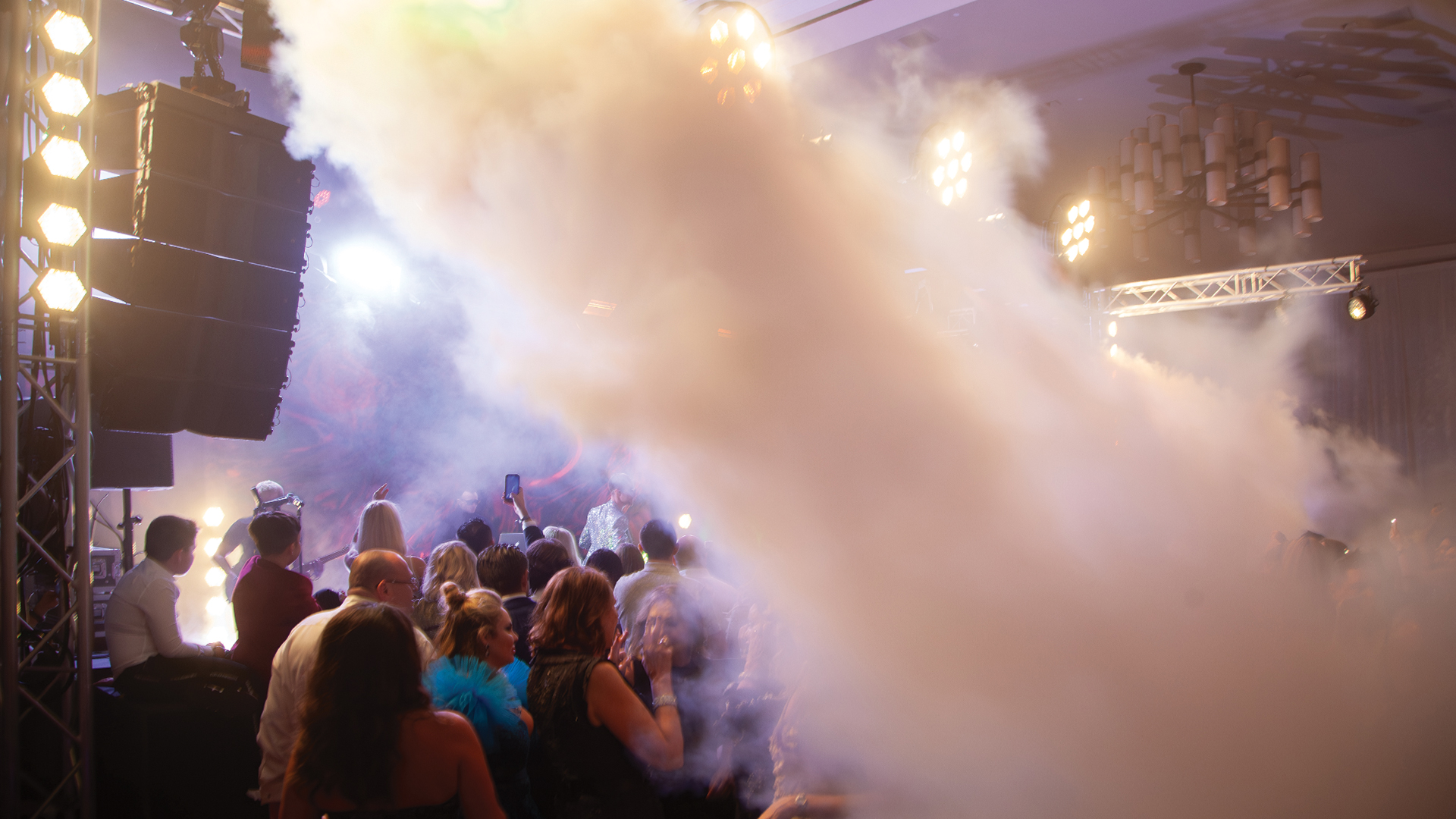
The atmospheric effects that transform live productions from performances into experiences rely on the predictable behavior of particles suspended in air. Fog and haze are supposed to follow the laws of physics—sinking, dispersing, and dissipating according to well-understood principles. Except when they don’t. These are the stories of atmospheric effects that developed their own agendas.
The MDG theONE Uprising
The MDG theONE represents the gold standard in theatrical haze generation—consistent output, minimal fluid consumption, and neutral-density particles that hang beautifully in light beams. Special effects technician Marcus Webb trusted his MDG fleet completely. Until a 2021 theater production taught him about the limits of that trust.
“We had four theONE units positioned to create a uniform atmospheric wash across the stage. The venue had balanced HVAC—we’d verified the air handling patterns with smoke pencils during tech. But opening night, the haze decided to stage its own show.”
Instead of creating a uniform atmosphere, the haze separated into distinct layers that moved independently across the stage. “You could see three or four horizontal strata of varying density, sliding past each other like geological formations in fast-forward. The lighting design featured downlight beam effects that required consistent haze density—instead, we got stripes of visible light separated by zones of nothing.”
Understanding the Thermal Layers
Investigation revealed a complex interaction between the lighting rig heat output and the venue’s climate control. “The LED fixtures we were using—mostly Chauvet Professional Maverick MK3 Spot—weren’t generating the thermal load we’d expected from conventional fixtures. The HVAC system, calibrated for a hotter lighting rig, was creating temperature differentials that stratified the atmosphere. We had to work with the venue to reduce airflow and allow natural convection from the lights to mix the air.”
The Low-Lying Fog That Climbed
True low-lying fog requires precise conditions—chilled fog that’s denser than ambient air, settling into a flowing carpet across the floor. Effects designer Sarah Chen deployed an Ultratec Radiance Hazer feeding into a cryogenic chiller system for a Broadway-style production. The fog had other plans.
“The first act went perfectly—ankle-deep fog rolling across the stage during the graveyard scene. But by act two, the fog started rising. Not dissipating—actively climbing. By the finale, what was supposed to be ground-hugging atmosphere was chest-height and still ascending.”
The phenomenon resulted from accumulated heat. “The stage floor had absorbed energy from the lighting instruments throughout the show. By act two, the floor surface was warm enough that our ‘cold’ fog wasn’t cold relative to the floor anymore. The temperature differential that made the fog sink had reversed. We installed chilled floor channels for subsequent performances.”
Historical Perspective: From Dry Ice to Digital Control
The history of theatrical fog effects begins with the simplest technology—dry ice dropped into hot water. The 19th-century stage used this technique for ethereal effects in productions ranging from opera to melodrama. The carbon dioxide vapor sinks reliably, but controlling its density and duration remained a challenge for decades.
The 1970s brought oil-based fog machines that could generate persistent atmospheric effects. Early units from companies like Rosco and Mole-Richardson established the basic principles of fluid vaporization that still underpin modern technology. The development of water-based fog fluids in the 1980s addressed health concerns while maintaining visual quality.
The Smoke Factory Portal Vortex
The Smoke Factory Portal DMX creates dense, burst-style fog effects perfect for concert and club environments. Special effects coordinator David Park deployed a bank of Portal units for an EDM festival and discovered that high-output fog bursts can interact with venue architecture in unexpected ways.
“The venue had a domed ceiling about 60 feet above the stage. When we fired the Portal bank during the bass drops, the fog would shoot upward, hit the dome, and start rotating. Within minutes, we had a visible vortex pattern forming—like a slow-motion tornado made of fog. The lighting designer started incorporating it into the show, but we had no idea initially why it was happening.”
The Science Behind the Spectacle
The vortex resulted from the dome’s geometry interacting with the fog’s thermal energy. “The fog arrived at the dome surface still carrying momentum and heat. The curved surface directed the flow into a circular pattern, and the Coriolis-like effect from the dome’s asymmetry started the rotation. Once established, the pattern was self-sustaining until we stopped adding fog energy. We actually documented the conditions and could reproduce it reliably.”
The Antari Z-Stream Horizontal Rebellion
The Antari Z-Stream haze machines deliver consistent atmospheric haze output through a continuous process rather than burst cycling. Lighting designer Jennifer Santos relied on Z-Stream units for a touring concert production and encountered behavior that challenged her understanding of fluid dynamics.
“We positioned the hazers downstage left and right, expecting the haze to drift upstage and fill the performance area. Instead, the haze moved directly toward each other, met in the middle of the stage, and created a dense vertical column that then split and moved offstage. The performers kept walking through this invisible curtain of concentrated haze.”
The cause was airflow from the main PA system. “The L-Acoustics K2 arrays were pushing enough air that they created a pressure pattern across the stage. The haze was following the path of least resistance, which happened to be straight toward center stage and then out through gaps in the coverage pattern. We had to coordinate hazer position with the sound system geometry to achieve the distribution we wanted.”
Practical Atmospheric Control Strategies
Managing atmospheric effects behavior requires understanding the venue as a complete system—not just the fog equipment in isolation. The first principle is comprehensive air movement mapping before committing to equipment positions.
Smoke pencils or theatrical trace smoke can reveal airflow patterns that would otherwise be invisible. Testing should occur with full HVAC operation and ideally with the lighting rig at show temperature—the thermal contribution of fixtures significantly affects atmospheric behavior.
Fluid Selection and Temperature
Different fog fluid formulations behave differently under identical conditions. Quick-dissipating fluids from manufacturers like Le Maitre and Froggy’s Fog minimize accumulation problems, while long-hang fluids create persistent effects that can become problematic if airflow changes.
For low-lying applications, maintaining consistent chiller temperatures is critical. The Look Solutions Cryo-Fog and similar cryogenic systems require careful temperature monitoring to ensure the fog remains dense enough to sink but not so cold it creates condensation issues on sensitive stage surfaces.
The Martin JEM K1 Hazer Integration Challenge
The Martin JEM K1 hazer offers robust construction and consistent output for touring applications. Production manager Robert Chen encountered an integration challenge when the K1’s behavior changed depending on its DMX control source.
“When controlled directly from the GrandMA3 console, the hazer performed perfectly. But when we added the effect to our show control system running through QLab, the output became inconsistent—sometimes full burst, sometimes nothing, occasionally random levels we hadn’t programmed.”
The issue traced to DMX refresh rate variations between the control sources. “The K1 firmware was sensitive to the timing of DMX packets in a way that caused it to interpret rapid-fire updates as oscillating commands. We solved it by adding a DMX buffer/merger that stabilized the signal before it reached the hazer.”
Fog and haze are the invisible architecture of light—without them, even the most sophisticated lighting rig produces only patches of illumination on surfaces. When these atmospheric elements behave unexpectedly, they remind us that production environments are complex systems where physics, chemistry, and thermodynamics all have opinions. The professionals who master these effects learn to read the air itself.
