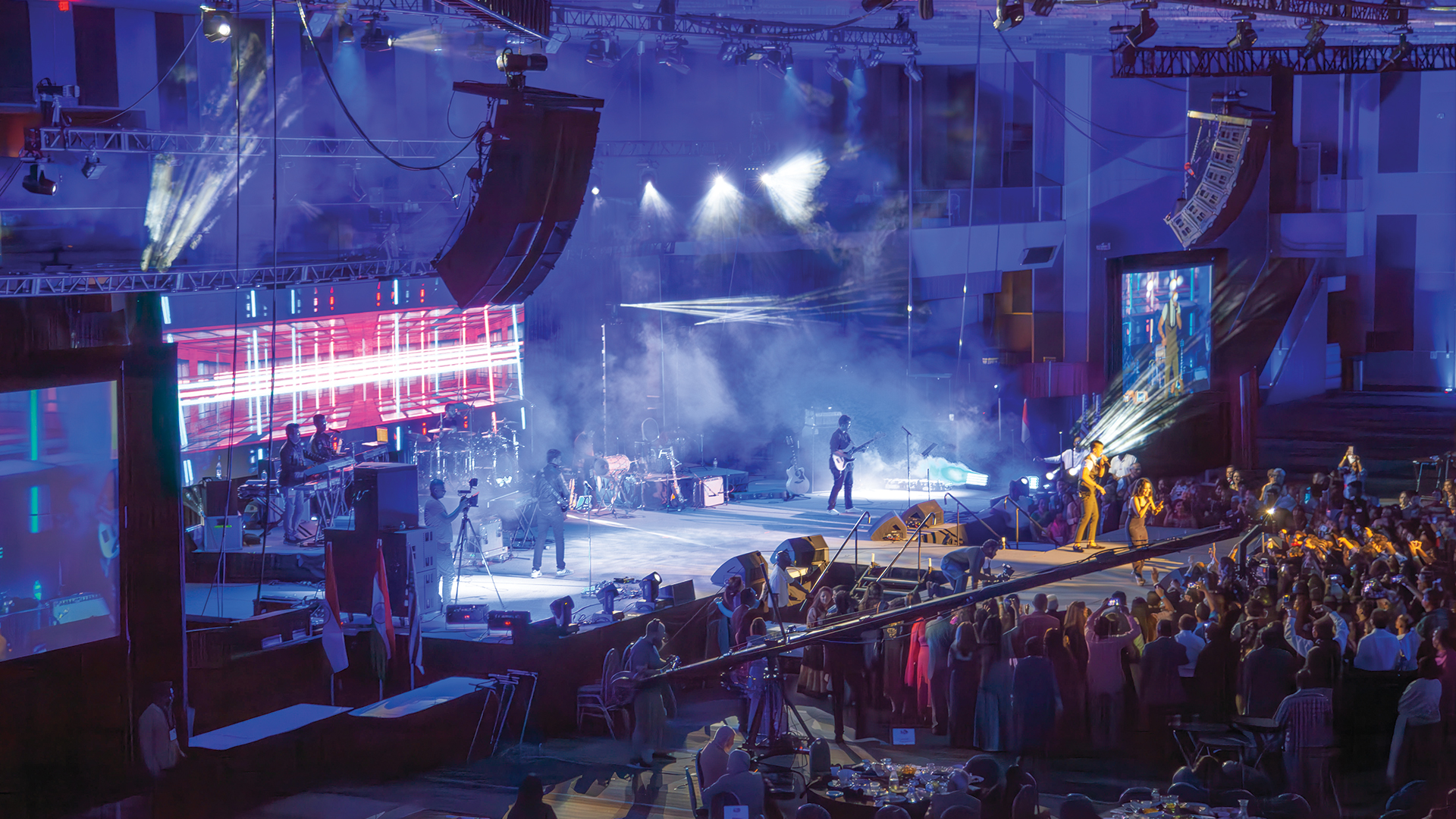
The arithmetic of a world tour is staggering: an A-list touring production ships its audio infrastructure across continents, climates, and customs jurisdictions for ten, eleven, sometimes twelve months without pause. The PA systems at the core of these productions — anchored by brands like JBL Professional, d&b audiotechnik, and L-Acoustics — travel distances that rival circumnavigating the globe multiple times. Understanding what makes these systems durable enough, flexible enough, and acoustically consistent enough to survive that kind of deployment is fundamental to the business of large-scale touring audio
The Three Pillars of Global Touring Audio
Each of the three dominant brands occupies a distinct philosophical and market position within the touring ecosystem. L-Acoustics, founded in France in 1984 by Dr. Christian Heil, pioneered the modern line array concept with the V-DOSC system in 1992 — a product that fundamentally rewrote expectations for outdoor concert sound coverage. The L-Acoustics K2 and K1 systems that dominate major touring today are direct descendants of that acoustic heritage, refined through decades of real-world deployment feedback into instruments of exceptional precision and reliability.
d&b audiotechnik, a Stuttgart-based engineering company with roots in German theatre and touring sound, built its global reputation on a different value proposition: the integration of amplification, signal processing, and acoustic hardware into tightly controlled, highly predictable systems. The d&b J-Series and GSL System earn extraordinary loyalty from audio engineers who prize the consistency that d&b’s amplifier-DSP-cabinet ecosystem delivers. When a d&b system is measured on-site and tuned in ArrayCalc, the real-world result reliably matches the simulation — a quality that becomes invaluable when a production is setting up in a different city every 48 hours.
JBL Professional, part of Harman and now Samsung’s broader electronics empire, brings a different legacy. JBL’s professional audio lineage stretches back to James B. Lansing’s work in the 1940s, and the brand’s VTX Series and SRX Line Array systems have logged hundreds of millions of cumulative audience exposures. JBL’s particular strength lies in its global rental network — the VTX A12 and VTX V25-II appear in rental inventories on every inhabited continent, making them a pragmatic choice for productions requiring consistent local gear augmentation rather than shipping entire systems internationally.
60,000 km: What That Number Actually Means Operationally
A touring production covering 60,000+ kilometres annually might include legs across North America, Europe, Asia-Pacific, and Latin America. Each leg requires the PA system to be packed into flight cases engineered to withstand repeated loading, temperature cycling from -20°C to 45°C, aircraft hold pressure differentials, and the accumulated mechanical stress of hundreds of truck road miles. The Hardigg and Zarges flight cases protecting touring-grade speaker cabinets cost $500–$2,000 per unit; a mid-size tour may have 100+ speaker cabinets, representing $150,000+ in case investment alone.
Amplifier racks — typically housing Lab.gruppen PLM 20000Q, Crown iTech 5000HD, or d&b D80 amplifiers — require even more careful case engineering. The electrical and thermal demands of these units, combined with the delicate DSP modules and network interfaces embedded within them, make vibration isolation a primary design concern. Custom rack builds from specialist companies like Duracase or Penn Fabrication integrate shock-mount rails, ventilation panels designed for airflow even in confined cargo positions, and cable management systems that survive hundreds of pack and unpack cycles.
Consistency Across Continents: The Calibration Challenge
Perhaps the most demanding aspect of global touring audio is not mechanical durability but acoustic consistency. An audience in Tokyo deserves identical sonic quality to one in Chicago or Amsterdam — and achieving that demands rigorous system calibration protocols executed by experienced system engineers in wildly varying acoustic environments. The industry-standard workflow combines Rational Acoustics Smaart measurement software with real-time transfer function analysis, drive rack alignment through Lake Mesa EQ or d&b R1 Remote Control Software, and pre-show walk of the listening area with calibrated measurement microphones
Productions travelling with their own dedicated system techs — a role distinct from the FOH mix engineer — maintain daily system health logs tracking driver performance, amplifier operating temperatures, and digital network integrity across Dante or AES67 audio-over-IP architectures. A system tech on a 200-show world tour will troubleshoot and resolve dozens of component failures during the run — blown HF drivers, failed amplifier channels, corrupted DSP configurations — without the show’s audience ever knowing.
Local Augmentation: The Art of System Matching
No global touring production ships 100% of its audio infrastructure to every venue. The practical logistics of international freight, local customs regulations, and the economics of air freight versus sea freight mean that most productions travel with a core system — typically the FOH main arrays and primary drive and processing rack — while contracting local rental companies to provide delay towers, front-fill systems, monitor packages, and infrastructure cabling
This creates an art form in itself: the matching of a touring L-Acoustics K1 main system to locally-sourced K2 or ARCS Wide delay elements, or integrating a d&b GSL tour system with regionally available J-Series augmentation. Production managers and system engineers build relationships with trusted local vendors — companies like Coda Audio distributors in Asia, Ampco-Flashlight in the Netherlands, Entourage Productions in Australia — whose inventory quality and technical competence they trust implicitly.
The Climate Factor: Engineering Resilience for Extreme Conditions
A touring system that works flawlessly in a temperature-controlled arena must survive a humid 38°C outdoor festival in Singapore, a high-altitude gig in the Andes, and a winter stadium date in Edmonton at -25°C. Transducer performance — specifically driver coil resistance, magnetic flux density, and enclosure resonance frequency — shifts measurably across temperature extremes. Both JBL VTX and L-Acoustics K Series cabinets undergo rigorous environmental testing as part of their development programmes, but the real education happens when a system tech notices the HF roll-off behaviour changing during a soundcheck in Kuala Lumpur compared to the previous night in Seoul.
Humidity is a particularly insidious threat. Moisture ingress into compression driver diaphragms causes temporary performance degradation and accelerated long-term failure. Climate-controlled flight cases — increasingly common in premium touring packages — represent a significant operational investment that pays dividends in reduced maintenance costs and component replacement frequency across a long touring year.
The Economics of Keeping 60,000 km of Sound on the Road
The financial architecture of major touring audio is complex. A production company might own $3M–$8M in touring audio infrastructure, amortised over a projected 5–7 year operational lifespan. Maintenance reserves, insurance, freight costs, and daily rental rates from production budgets must all be modelled to make ownership economically rational versus sourcing from a major rental house. Companies like PRG, VER, and Solotech offer structured long-term rental agreements that transfer maintenance risk and capital requirements away from production companies — an arrangement that has become increasingly common as PA system complexity and replacement part costs have risen.
For the audio professionals who maintain, deploy, and operate these systems across 60,000+ touring kilometres, the work is a masterclass in combining acoustic science, logistics discipline, and professional craftsmanship under relentless time pressure. The result, night after night, is sound that transforms a crowd into a shared experience.
