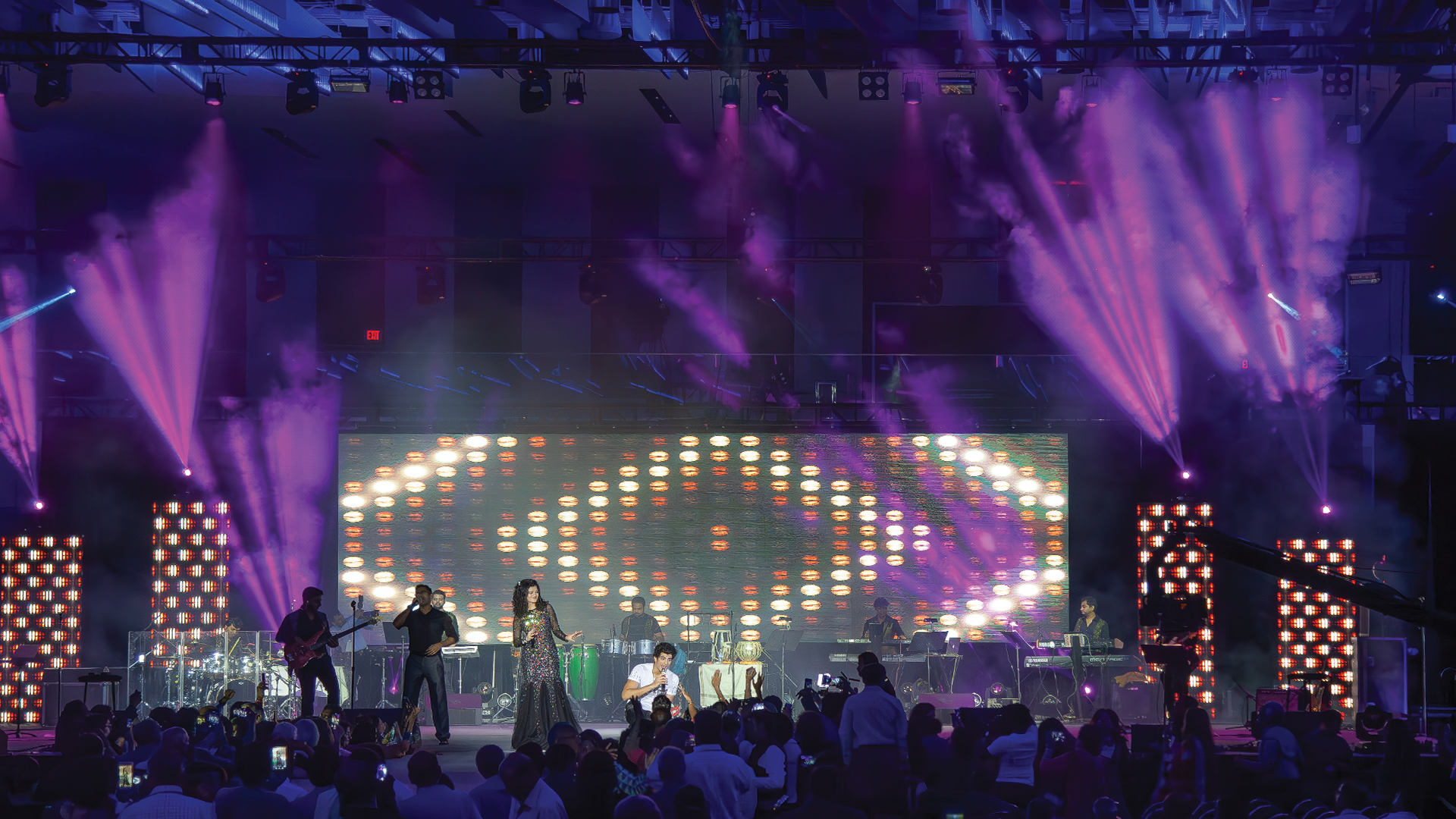
The relationship between LED wall technology and multi-camera broadcast has become one of the most dynamic creative and technical collaborations in contemporary media production. What began as a challenge — LED walls creating moiré patterns, refresh rate conflicts, and colour science headaches for broadcast cameras — has evolved into a purposeful, sophisticated integration where LED surfaces are designed and mapped specifically to enhance rather than complicate the broadcast product. The productions achieving this synthesis are setting new creative standards for television, streaming, and live event broadcast.
The Historical Problem: LED and Camera in Conflict
Early integration of LED video walls into broadcast environments produced immediate technical friction. Consumer and even early professional LED panels refreshed at rates — typically 480 Hz to 1,920 Hz — that interacted problematically with broadcast camera shutter speeds, creating horizontal black bands, flickering, and luminance instability in the recorded image. Colour gamut mismatches between LED panel colour profiles and broadcast camera colour spaces (typically Rec. 709 or emerging Rec. 2020 for HDR workflows) produced on-camera colour rendering that bore little resemblance to what the naked eye perceived on the floor.
The resolution came through combined advances in panel hardware and operational practice. Manufacturers including ROE Visual, Absen, and Unilumin began offering panels with high-speed PWM refresh rates of 3,840 Hz and above — specifically to eliminate camera-visible flicker at all standard broadcast frame rates including 24p, 25p, 30p, 50i, 59.94p, and 60p. Simultaneously, processors like Brompton Technology Tessera introduced Extended Bit Depth (XBD) processing that dramatically improved low-brightness luminance smoothness — addressing the ‘dirty black’ artefacts that plagued earlier broadcast LED deployments.
Content Mapping Philosophy: Designing for Camera, Not Eye
The most significant shift in broadcast LED wall production has been the deliberate design of content for the camera rather than the room. A virtual production environment using LED walls as background plates — the technology popularised by productions like The Mandalorian and deployed across dozens of subsequent productions — requires content mapped to camera perspective rather than audience perspective. The in-camera visual effects (ICVFX) workflow uses real-time game engines, most commonly Unreal Engine 5, to render camera-tracked background content that maintains correct perspective parallax as cameras move. Mo-Sys StarTracker and Stype HydraX tracking systems feed camera position data into Unreal in real time, enabling seamless environmental integration.
For live concert broadcast, the challenge is different but equally demanding. Content on a touring LED wall designed for house audience enjoyment often appears blown-out, overly saturated, or visually chaotic when captured by broadcast cameras optimised for natural dynamic range. Production companies like Fulwell 73, Done+Dusted), and Silent House have developed broadcast overlay workflows where a parallel content stream — colour-graded and processed specifically for camera capture — is fed to an invisible layer within the Disguise d3 media server, mixed with the live performance content through luma-key or chroma-key compositing in real time.
The Role of LED Processors in Broadcast Integration
At the intersection of LED content and broadcast camera chain sits the LED processor — and specifically, the colour science capabilities of platforms like Brompton Tessera SX40 and Novastar VX1000. Brompton’s Hydra Dynamic Range technology processes per-pixel luminance mapping to create panel behaviour that broadcast cameras can capture accurately across a wide dynamic range. The ability to set camera-optimised brightness curves independently from the audience-facing brightness profile allows operators to maintain visual impact in the room while delivering a technically superior camera picture simultaneously — a dual-output capability that transforms LED wall operation in broadcast contexts.
Colour calibration for broadcast LED walls involves matching panel output to broadcast camera sensor profiles using hardware calibration tools including Photo Research PR-735 spectroradiometers and Klein K-10A colorimeters. This is not a visual calibration process but a scientific one, with results expressed in CIE xy chromaticity coordinates and verified against the target colour space using vectorscope analysis on broadcast monitors. Productions with dedicated LED DIT (Digital Imaging Technician) roles — emerging as a distinct crew position on major broadcast events — represent the current best practice for maintaining this calibration standard across multi-day events.
Multi-Camera Planning and LED Wall Interaction
Planning multi-camera broadcast around an LED wall environment requires camera placement strategy that accounts for the moire and refresh rate characteristics of specific panel products. Camera operators on broadcast productions using LED backdrops are briefed on ‘safe zones’ — camera positions and focal lengths that reliably avoid moire interference with specific panel products at specific shooting distances. This knowledge is developed during pre-production camera test days using the actual panel configuration and camera package that will be deployed on-air.
The use of defocus techniques — deliberately operating certain background cameras at slight defocus to smooth LED panel grid structure — has been institutionalised on productions like music award shows and live concert specials. The creative tension between sharp performance capture and managed background texture has produced a distinctive aesthetic vocabulary for this genre of production that has become recognised and expected by audiences.
The Broadcast Mixing Architecture: Keeping LED and Camera in Perfect Sync
The technical backbone of a major broadcast production incorporating LED wall environments includes a synchronised genlock reference distributed across all cameras, LED processors, and content servers. Without a shared black burst or tri-level sync signal — typically distributed from a Evertz or Ensemble Designs sync generator — the relationship between camera shutter timing and LED refresh cycles drifts unpredictably, producing inconsistent picture quality. This genlock distribution is the invisible infrastructure that enables everything else in the broadcast LED workflow to function coherently.
As virtual production stages proliferate and live concert broadcast continues raising its production values, the integration of LED wall mapping with multi-camera broadcast is no longer an advanced specialisation — it is a foundational competency for any production professional working in contemporary live or studio media.
