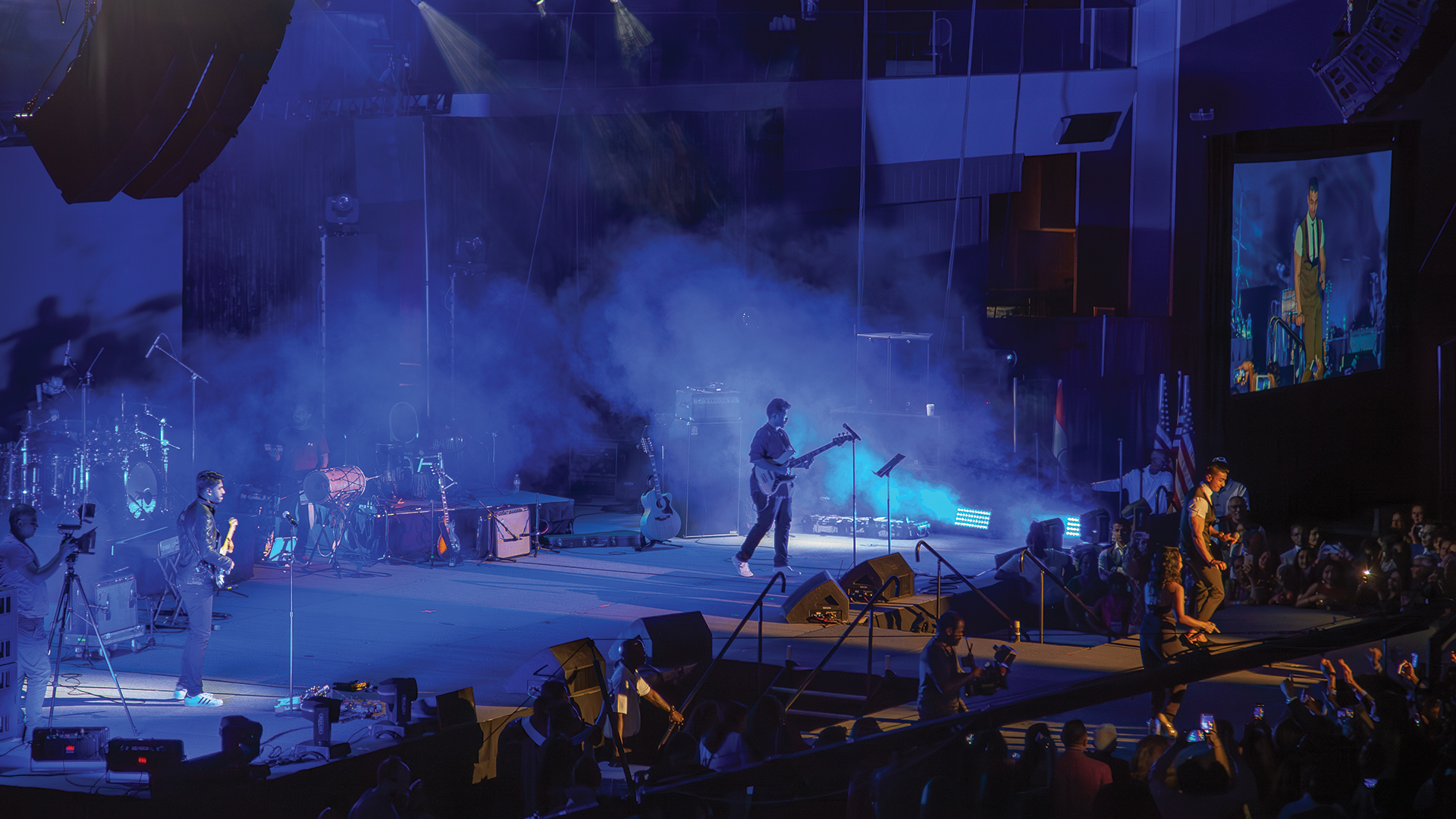
Stand at position 80 metres back from the main stage at a 75,000-capacity outdoor festival and consider the physics of what you are hearing. The sound from the main array has travelled roughly 0.23 seconds to reach you — long enough that, without intervention, you would hear a distinct pre-echo of everything from the delay towers positioned 40 metres to your left and right, followed a fraction of a second later by the main system. This temporal mismatch is not an inconvenience. It is a psychoacoustic assault that destroys intelligibility. The delay tower — and the science of deploying it correctly — is what stands between acoustic chaos and a coherent listening experience for tens of thousands of people.
The Physics of Distance: Why Delay Towers Are Non-Negotiable
Sound travels at approximately 343 metres per second at 20°C. At 80 metres from a main stage PA, that means the primary system signal arrives 233 milliseconds after leaving the speaker. A delay tower system positioned at 40 metres, without time correction, would reach a rear-positioned listener approximately 117 milliseconds after the main system — creating a disturbing double-image effect that makes lyrics unintelligible and music disorienting. The solution is as elegant as the problem: add precisely the right delay to the tower signal so that its output arrives at the listener’s ears 10–20 milliseconds after the main system rather than before it. This ‘Haas effect’ window fuses the two sources perceptually into a single, louder, clearer sound impression.
Calculating and implementing this delay requires dedicated system processing. Modern delay management is handled through outboard processors like the Lake LM 44 or within the DSP of amplifier platforms like Lab.gruppen PLM 20000Q, d&b D80, or Crown iTech 5000HD. Measurement-driven optimisation using Rational Acoustics Smaart or Meyer Sound SIM3 confirms that calculated delays match actual field performance, accounting for temperature, humidity, and wind effects on acoustic propagation velocity that can shift real-world delay requirements by ±5 milliseconds on extreme festival days.
Tower Placement and Geometry: The Pre-Production Engineering Challenge
Effective delay tower placement for a 75,000+ audience is not a field decision made during load-in. It is a pre-production engineering exercise conducted months in advance using acoustic simulation software. Festival site plans, audience capacity zones, and stage geometry are imported into L-Acoustics Soundvision, d&b ArrayCalc, or EASE Focus to model coverage contours from both main and delay positions. The goal is a defined SPL uniformity across the audience — typically ±3–4 dB variance across the full listening area — that requires careful modelling of delay tower height, downtilt angle, and array length.
Tower structural design is its own engineering discipline. Temporary delay towers supporting 500–1,500 kg of line array at heights of 12–20 metres require structural engineering sign-off and wind loading analysis. Companies specialising in this work — including TAIT Towers, Stageco, and Sixty82 — produce modular delay tower systems with rated load capacities and wind survival specifications documented for permitting purposes. Anchor systems — whether concrete ballast, ground screw anchors, or engineered deadweight solutions — are calculated against worst-case Beaufort scale wind speeds for the specific geography of each event site.
Line Array Selection for Delay Applications
Not every line array system is equally suited to delay tower applications. The primary requirement is a controlled vertical directivity pattern that minimises ground reflection and maximises intelligibility in the mid-distance audience zone the tower is serving. L-Acoustics KARA II, d&b V-Series, and Meyer Sound LEOPARD are among the most frequently specified systems for delay tower applications, with their compact form factors, high maximum SPL relative to size, and predictable directivity patterns making them efficient delay position solutions.
The splay angles between individual line array enclosures in a delay tower cluster are set to control the vertical coverage pattern. A tight splay of 0.5–1° between cabinets creates a long-throw, narrow vertical beam appropriate for addressing distant audience sections. A wider 2–4° splay broadens coverage for tower positions serving audience areas with significant vertical spread. These angles, calculated in manufacturer prediction software and confirmed with measurement tools, are set using the mechanical adjustment mechanisms built into line array rigging hardware from companies including Liftket and CM Lodestar
Power and Signal Distribution to Delay Tower Positions
Getting signal and power to delay towers positioned 40–100 metres from the main stage introduces its own engineering challenges. Long cable runs at audio signal level incur both capacitive loading and electromagnetic interference risks that degrade signal quality — addressed through the use of active direct injection at FOH and transformer-balanced line drivers at tower amplifier rack inputs. For very long runs, the industry has largely transitioned to AES/EBU digital audio transmission or audio-over-IP via Dante or AES67 over fibre-optic backbone cables, which eliminate both analogue signal degradation and the weight/cost of heavy copper multicore cable.
Power distribution to remote delay positions requires coordination with site electrical infrastructure. Temporary generator sets from providers like Aggreko or APR Energy are often positioned closer to delay tower locations than to the main stage, reducing the voltage drop across long power cable runs. Proper earthing and bonding of remote electrical distribution infrastructure is both a safety requirement and a audio noise floor consideration — poorly bonded remote earth points introduce ground loop hum that can compromise system performance at full production volume.
The Human Element: System Techs and Delay Tower Performance
A delay tower system that performs brilliantly during soundcheck can drift significantly during a show as audience-induced absorption, temperature changes from body heat, and atmospheric shifts alter acoustic conditions. Experienced system engineers monitor delay tower coverage zones during performances, making real-time EQ and level adjustments through remote control software like d&b R1, L-Acoustics LA Network Manager, or Crown BLU link platforms. The discipline of keeping 75,000+ people in a coherent acoustic environment while a performance is underway is quiet, invisible work — but it is the difference between a show that is simply loud and one that is truly professionally delivered
From ancient amphitheatres that used natural bowl geometry to focus sound to the precision delay engineering of modern mega-festivals, the challenge of covering large audiences has always defined the best of acoustic engineering. Today’s delay tower science is the contemporary answer to a challenge as old as performance itself.
