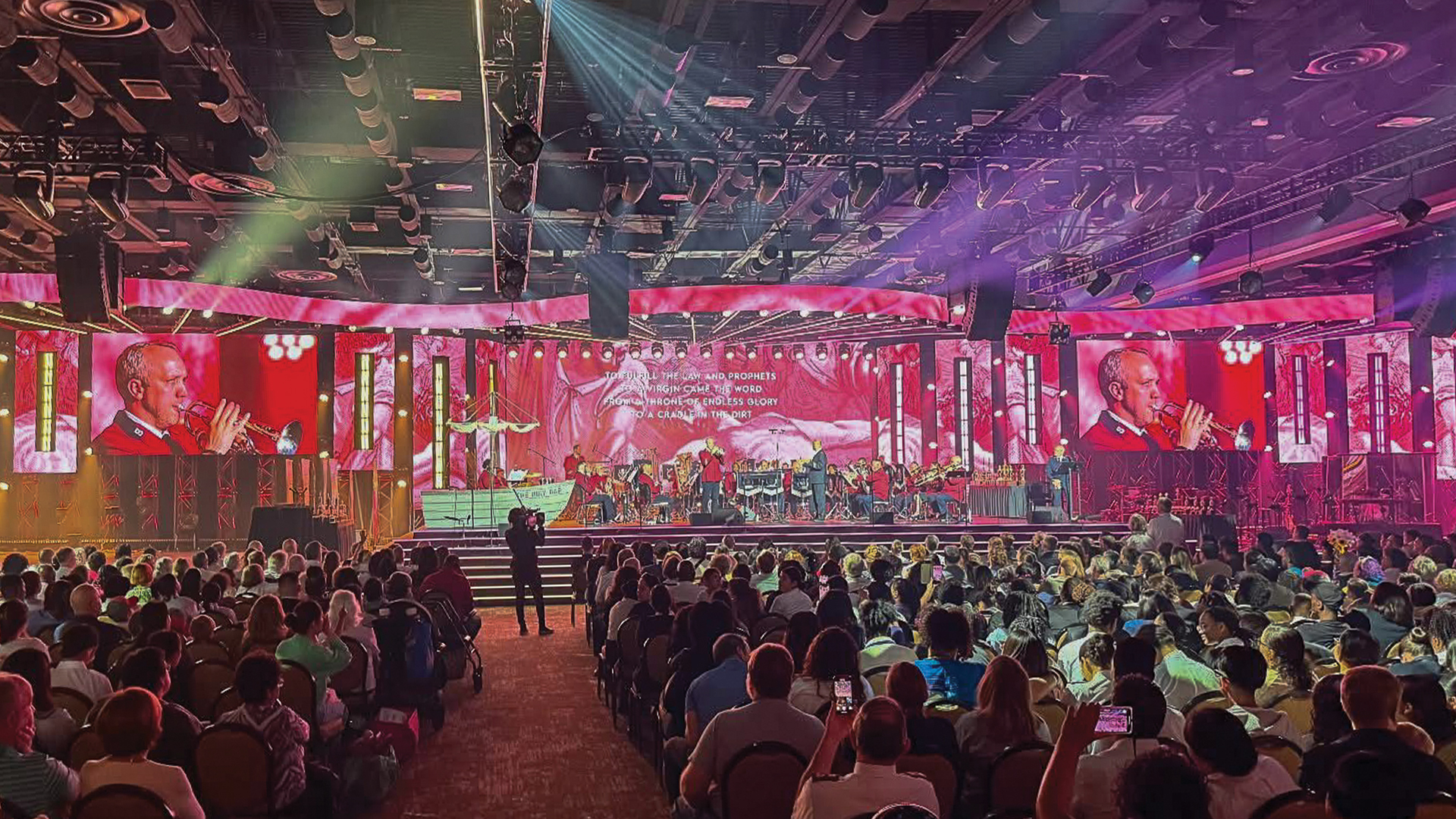
There is a moment familiar to every working system engineer: standing in an empty venue at 7 AM, laptop open on L-Acoustics Soundvision or d&b ArrayCalc), staring at the coverage predictions for a configuration that worked perfectly in the simulation but has just been adjusted to account for a lighting truss that occupies the space the array was supposed to fly in. The tilt angle needs to change. The splay between modules needs recalculation. The delay trim needs revisiting. These are not simple adjustments — they cascade through the entire acoustic architecture of the configuration. This is line array optimisation in practice: iterative, technically demanding, and absolutely determining of the audience experience.
The Fundamentals of Tilt and Splay
A line array system achieves its characteristic controlled vertical directivity through coherent acoustic summation between adjacent enclosures. The inter-module splay angle — the angular gap between adjacent cabinets — controls the vertical dispersion of the array. A splay of 0° creates a fully coupled cylindrical wavefront with maximum throw and very tight vertical control. Increasing splay progressively broadens vertical dispersion, trading throw distance for coverage width. The art lies in configuring splay progressively — tight at the top of the array for long-throw coverage to the back of the audience, opening progressively toward the bottom for near-field coverage — creating a progressive splay configuration that maintains consistent SPL across the full audience depth.
Array tilt — the overall angle of the array relative to vertical — positions the axis of maximum output over the centre of the intended coverage zone. For a stadium upper-tier array flying 20 metres above the stage and covering a seating tier 60 metres away and 30 metres below, the tilt angle must be precisely calculated to avoid wasting coverage into the ceiling or the floor in front of the audience. Errors of even 2–3° in tilt translate to SPL variations of 4–6 dB across the coverage zone — the difference between a consistent and an uneven audience experience.
Prediction Software: The Primary Optimization Tool
The transformation of line array deployment over the past two decades has been driven largely by the sophistication of manufacturer prediction software. L-Acoustics Soundvision — available as a free download and used by professionals worldwide — allows system engineers to import venue geometry, position virtual array assemblies, and calculate coverage SPL, frequency response uniformity, and direct-to-reverberant ratio across any listener position within the model. The software’s Directivity Data Format (DDF) uses measured impulse response data from every combination of array module type and inter-module splay, giving predictions accuracy sufficient for professional deployment decisions.
d&b ArrayCalc approaches the same problem with d&b’s proprietary acoustic model, incorporating both point source and line source behavioural models depending on array configuration and frequency. The specific acoustic character of d&b cabinets — engineered to maintain consistent directivity pattern as arrays scale — makes ArrayCalc predictions particularly reliable, contributing to d&b’s reputation for ‘what you simulate is what you get’ deployment accuracy. For engineers working across both platforms, the philosophical differences between Soundvision and ArrayCalc reflect deeper differences in system design philosophy between the two manufacturers.
The 600+ Venue Challenge: No Two Rooms Are Alike
A system engineer deploying across 600+ venue configurations over a career encounters every conceivable acoustic environment: purpose-built concert halls with optimised reverberation characteristics, outdoor amphitheatres with reflective concrete bowls, indoor arenas with steel roof structures creating violent high-frequency reflections, temporary festival stages in open fields with no reflective surfaces at all. Each environment demands a fundamentally different array optimisation strategy because the acoustic context in which the array operates determines how its output integrates with the listening environment.
In a highly reverberant indoor arena — common in North American hockey venues pressed into concert service — tight vertical control is paramount. Array configurations prioritise minimal splay to reduce floor and ceiling excitation, with aggressive high-pass filtering on delayed near-field elements to reduce reverberant field energy in the problematic 500 Hz–2 kHz intelligibility range. The L-Acoustics K1 or d&b J-Series systems used in these environments carry the directivity control capability required for this application — but only when their mechanical and processing optimisation is executed by engineers who understand both the acoustic physics and the venue-specific challenges involved.
Mechanical Optimisation: The Hardware of Splay Control
The mechanical precision of splay angle setting determines whether software optimisations translate to real-world performance. Modern line array rigging hardware from L-Acoustics), d&b), and third-party rigging specialists like Liftket and R&M Materials Handling provides splay angle adjustment in increments of 0.5°–1°, achievable through calibrated mechanical stops or bolted rigging frames. On arrays of 16+ enclosures, setting each inter-module splay with ±0.25° accuracy — using digital inclinometers or the calibrated tools supplied by manufacturers — takes 2–3 hours for an experienced crew and is not a step that can be rushed without compromising the array’s acoustic behaviour.
The introduction of motorised rigging systems for line arrays — allowing remote splay angle adjustment from the system engineer’s measurement position — has transformed the optimisation workflow for installations and long-running shows. Systems from TAIT Towers) and StageCo with motorised rigging integration allow a system engineer to adjust a 24-cabinet array’s splay configuration while continuously measuring the acoustic response — iterating toward an optimal configuration without repeated physical access to the array at height.
EQ and DSP Optimisation: The Software Layer
Mechanical splay optimisation addresses the macroscopic directivity behaviour of the array. Fine-grained acoustic optimisation requires a subsequent layer of DSP correction applied through the array’s drive processing. The L-Acoustics LA-RAK AVB or d&b R1 amplifier network enables per-cabinet level and delay adjustments that fine-tune the summation behaviour of the array beyond what mechanical splay control alone can achieve. For arrays covering challenging geometries — curved audience tiers, asymmetric room shapes, or mixed indoor-outdoor environments — these per-cabinet adjustments represent the difference between a passable and a professional result.
Across 600+ configurations, the defining characteristic of excellence in line array optimisation is not the possession of the right software or hardware — it is the accumulated judgement to interpret measurement data correctly, understand the physical causes of deviations from prediction, and make informed decisions about which compromises are acoustically acceptable in a given venue. That judgement is the product of years, and it is what separates the best system engineers in the touring world from everyone else.
